dilluns, d’octubre 19

Aquella bilis negra.


"La forma en la que mejor podríamos comprender la melancolía es la de una antinomia circular, un desequilibrio que hace girar en la misma rueda la genialidad o la locura, uncidas a una condición común: su caràcter desmesurado, una situación "exal" o de exilio de los estados de ánimo medios cotidianos, pagada al alto precio de la caída en la sima del abatimiento total y la alienación social -en el sentido más extenso del término, con extrañeza y extranjería."
Hubert Tellenbach. LA MELANCOLÍA.


Davant un món rar i sense sentit, els éssers humans esdevenen víctimes i monstres del que els envolta. Alguns, davant la misèria on estan submergits, arribaran a copsar el sentim sublim de la perfecció. Ells seran els cridats a sobrepassar per sobre la repulsió de l'entorn, vers una capacitat superior.

"Aquel cuyas emociones le inclinan a la melancolía no tiene ese nombre porque se sienta afligido por depresión, sombra al verse despojado de las alegrías de la vida, sino porque su sensibilidad, afinada por encima de determinado nivel, o mal dirigida por alguna razón, alcanza ese estado con mayor felicidad que ningún otro. En particular, tiene el sentido de lo sublime... Todas las sensaciones de lo sublime poseen para él una mayor fascinación que los encantos efímeros de lo bello."
Immanuel Kant. OBSERVACIONES SOBRE EL SENTIMIENTO DE LO BELLO Y LO SUBLIME.

La melangia com la recerca de la perfecció en un món de limitacions. La malenconia com el pont entre la tristesa i l'exaltació. El spleen com a genialitat creativa per si mateix. L'artista passarà pels abismes profunds i arribarà a majors cotes d'abstracció, si és capaç de caminar per l'estret traç que separa la genialitat i la bogeria. El creador d'un destí excels, serà limitat per l'estructura del seu propi art. Les fronteres de la creació faran referència al que no es vol acotar, creant la sensació malenconiosa en l'ànima de l'autor, ja que ell mateix posarà llindars a l'horitzó. No serà una fugida completa, sinó parcial, perquè quan més proper serà el resultat, més lluny estarà la seva fita.

"Cada cual es para sí mismo el más lejano."
Friedrich Wilhelm Nietzsche.


Tanco el calaix, després de rellegir i reescriure unes velles paraules: V. 21.02.08.


Pintura escapçada de Giorgio de Chirico, Mystery and Melancholy of a Street, 1914.

dimecres, d’octubre 14

Bad Blake.


'If the doors of perception were cleansed
every thing would appear to man as it is:
infinite.
For man has closed himself up,
till he sees all things thro' narrow chinks
of his cavern'.
The marriage of heaven and hell.


William Blake (1757-1827): visonari, poeta, dibuixant, pintor i gravador anglès. Considerat en el seu temps com a poeta fosc, al.lucinat, mancat de coherència i aliè a qualsevol tradició: Bad Blake.Figura autodidàctica allunyada dels mitjans acadèmics convencionals. La seva passió pel coneixement el va dur a una sistemàtica i meditada lectura dels grans pensadors, místics i poetes de totes les èpoques.

"Esta ha sido mi herencia celestial:
Milton me amó de niño y me descubrió el rostro
Ezna vino con Isaías el profeta,
pero en años de madurez, Shakespeare me tendió su mano
Paracelso y Böhme se presentaron ante mí,
grandes terrores aparecieron en los cielos
y abajo en los infiernos: un cambio extraordinario
y terrible amenazaba la tierra".
Fragment de la carta a l'escultor i amic J. Flaxman, 12 setembre 1800.

Quatre van ser els aspectes socials que es reflexaven en les seves idees i actitud: industrialització, religió organitzada, política social i relació entre sexes.Anarquista místic en contra del racionalisme llibertari de l'època, denunciava sistemàticament els abusos de poder i de la propietat privada.

"¿Con qué sentido exige el párroco su diezmo al campesino?
Cuáles son sus trampas, cebos y artimañas,
cómo le circunda con bosques de soledad,
con fríos diluvios de abstracción,
para que levante castillos y enhiestos pináculos
en que reyes y sacerdotes puedan morir."
Visiones de las hijas de Albión,5: 17-20.

Blake criticava l'opressió de l'Estat, denunciant la pobresa econòmica que patia la gent: estava en contra de qualsevol forma d'autoritarisme, tant a nivell polític, com religiós, sexual o artístic. Ell veia clarament la mecanització de l'univers, i que aquesta comportaria paral.lelament la mecanització de la societat i de la propia imatge que l'home rebia d'ell mateix. La substitució de la religió per la raó era suplantar un error per un altre, perquè comportava la deshumanització social.

"Ver un mundo en un grano de arena
y el cielo en una flor silvestre,
abarcar el infinito en la palma de la mano
y la eternidad en sólo una hora."
Augurios de Inocencia.

Blake estimava l'aventura del coneixement, en veure-hi implícita, en ella, la unió de la inocència i de l'experiència. Però, també veia que, l'educació en mans de la classe dirigent seria controlada en benefici dels seus propis interessos, com a mitjà de propaganda.

"Vuelvo la mirada hacia escuelas y universidades de Europa
y veo allí el telar de Locke y su trama, causa de horribles estragos,
bañado por las ruedas hidráulicas de Newton. Negro paño
que se enrosca pesadamente en las naciones: con crueles mecanismos
de múltiples ruedas, las cuales contemplo,
rueda moviendo a la rueda con tiránicos dientes
moviéndose por compulsión unas a otras,
no como sucede en Edén donde, rueda dentro de la rueda,
giran en libertad, paz y armonia."
Jerusalén, 15: 14-20.

Blake considerava el poeta com a un visionari, un vident dotat de la facultat de penetrar en la veritat fantàstica dels cosmos, exaltant l'activitat creadora de la imaginació.

"Un profeta es alguien que ve, no un dictador arbitrario."
Anotaciones a Watson.

Bad Blake: dualista gnòstic, filòsof de contraris, crític davant la religió i la raó, poeta complex amb gran capacitat de síntesi i àgil dialèctica. Poeta pre-romàntic. Artista sui generis. Mag de l'ambigüetat, situat al final de la tradició puritana on el radicalisme gnòstic anava de la mà del fervor religiós. No entès en el seu temps.Com deia ell: tot dependrà del que es vol veure.

"The hours of folly are measur'd by the clock
but of wisdom: no clock can measure."
Proverbs of Hell.


Tanco el calaix, després de rellegir i reescriure unes velles paraules: William Blake, 25.09.07

Pintura escapçada de Thomas Phillips, retrat de William Blake, 1807.

diumenge, d’octubre 4

Per llegir i escoltar abans d'anar a dormir.


Recordo que el primer relat que vaig llegir d'ell, va ser El Gat Negre. Des de llavors m'ha acompanyat, inclús diria que més d'un cop m'ha bressolat abans de dormir-me. El mestre dels contes de terror psicològic sempre m'ha admirat. La seva capacitat d'embolcallar-me amb unes falses aparences que cauen, desvetllant aquell horror que s'arrela i que no es pot expressar amb paraules, no ha minvat amb el temps. Així que, si he de parlar d'escriptors de capçalera, Poe, que camina per aquella corda fluixa entre la genialitat i la bogeria, i la seva obra, hi tenen un lloc.


The Raven, publicat per primer cop el 1845, ...

Once upon a midnight dreary, while I pondered, weak and weary,
Over many a quaint and curious volume of forgotten lore,
While I nodded, nearly napping, suddenly there came a tapping,
As of someone gently rapping, rapping at my chamber door."
'Tis some visitor," I muttered, "tapping at my chamber door;
Only this, and nothing more."

Ah, distinctly I remember, it was in the bleak December,
And each separate dying ember wrought its ghost upon the floor.
Eagerly I wished the morrow; vainly I had sought to borrow
From my books surcease of sorrow, sorrow for the lost Lenore.
For the rare and radiant maiden whom the angels name Lenore,
Nameless here forevermore.

And the silken sad uncertain rustling of each purple curtain
Thrilled me---filled me with fantastic terrors never felt before;
So that now, to still the beating of my heart, I stood repeating,"
'Tis some visitor entreating entrance at my chamber door,
Some late visitor entreating entrance at my chamber door.
This it is, and nothing more."

Presently my soul grew stronger; hesitating then no longer,
"Sir," said I, "or madam, truly your forgiveness I implore;
But the fact is, I was napping, and so gently you came rapping,
And so faintly you came tapping, tapping at my chamber door,
That I scarce was sure I heard you." Here I opened wide the door;---
Darkness there, and nothing more.

Deep into the darkness peering, long I stood there, wondering, fearing
Doubting, dreaming dreams no mortals ever dared to dream before;
But the silence was unbroken, and the stillness gave no token,
And the only word there spoken was the whispered word,
Lenore?, This I whispered, and an echo murmured back the word,
"Lenore!" Merely this, and nothing more.

Back into the chamber turning, all my soul within me burning,
Soon again I heard a tapping, something louder than before,
"Surely," said I, "surely, that is something at my window lattice.
Let me see, then, what thereat is, and this mystery explore.
Let my heart be still a moment, and this mystery explore."
'Tis the wind, and nothing more."

Open here I flung the shutter, when, with many a flirt and flutter,
In there stepped a stately raven, of the saintly days of yore.
Not the least obeisance made he; not a minute stopped or stayed he;
But with mien of lord or lady, perched above my chamber door.
Perched upon a bust of Pallas, just above my chamber door,
Perched, and sat, and nothing more.

Then this ebony bird beguiling my sad fancy into smiling,
By the grave and stern decorum of the countenance it wore,
"Though thy crest be shorn and shaven thou," I said, "art sure no craven,
Ghastly, grim, and ancient raven, wandering from the nightly shore.
Tell me what the lordly name is on the Night's Plutonian shore.
"Quoth the raven, "Nevermore."

Much I marvelled this ungainly fowl to hear discourse so plainly,
Though its answer little meaning, little relevancy bore;
For we cannot help agreeing that no living human being
Ever yet was blessed with seeing bird above his chamber door,
Bird or beast upon the sculptured bust above his chamber door,
With such name as "Nevermore."

But the raven, sitting lonely on that placid bust, spoke only
That one word, as if his soul in that one word he did outpour.
Nothing further then he uttered; not a feather then he fluttered;
Till I scarcely more than muttered, "Other friends have flown before;
On the morrow he will leave me, as my hopes have flown before."
Then the bird said, "Nevermore."

Startled at the stillness broken by reply so aptly spoken,
"Doubtless," said I, "what it utters is its only stock and store,
Caught from some unhappy master, whom unmerciful disaster
Followed fast and followed faster, till his songs one burden bore,---
Till the dirges of his hope that melancholy burden bore
Of "Never---nevermore."

But the raven still beguiling all my sad soul into smiling,
Straight I wheeled a cushioned seat in front of bird, and bust and door;
Then, upon the velvet sinking, I betook myself to linking
Fancy unto fancy, thinking what this ominous bird of yore --
What this grim, ungainly, ghastly, gaunt and ominous bird of yore
Meant in croaking "Nevermore."

Thus I sat engaged in guessing, but no syllable expressing
To the fowl, whose fiery eyes now burned into my bosom's core;
This and more I sat divining, with my head at ease reclining
On the cushion's velvet lining that the lamplight gloated o'er,
But whose velvet violet lining with the lamplight gloating o'er
She shall press, ah, nevermore!

Then, methought, the air grew denser, perfumed from an unseen censer
Swung by seraphim whose footfalls tinkled on the tufted floor.
"Wretch," I cried, "thy God hath lent thee -- by these angels he hath
Sent thee respite---respite and nepenthe from thy memories of Lenore!
Quaff, O quaff this kind nepenthe, and forget this lost Lenore!"
Quoth the raven, "Nevermore!"

"Prophet!" said I, "thing of evil!--prophet still, if bird or devil!
Whether tempter sent, or whether tempest tossed thee here ashore,
Desolate, yet all undaunted, on this desert land enchanted--
On this home by horror haunted--tell me truly, I implore:
Is there--is there balm in Gilead?--tell me--tell me I implore!"
Quoth the raven, "Nevermore."

"Prophet!" said I, "thing of evil--prophet still, if bird or devil!
By that heaven that bends above us--by that God we both adore--
Tell this soul with sorrow laden, if, within the distant Aidenn,
It shall clasp a sainted maiden, whom the angels name Lenore---
Clasp a rare and radiant maiden, whom the angels name Lenore?
Quoth the raven, "Nevermore."

"Be that word our sign of parting, bird or fiend!" I shrieked, upstarting--
"Get thee back into the tempest and the Night's Plutonian shore!
Leave no black plume as a token of that lie thy soul hath spoken!
Leave my loneliness unbroken! -- quit the bust above my door!
Take thy beak from out my heart, and take thy form from off my door!"
Quoth the raven, "Nevermore."

And the raven, never flitting, still is sitting, still is sitting
On the pallid bust of Pallas just above my chamber door;
And his eyes have all the seeming of a demon's that is dreaming.
And the lamplight o'er him streaming throws his shadow on the floor;
And my soul from out that shadow that lies floating on the floor
Shall be lifted---nevermore!


... de la veu de Vincent Price.


Il.lustració escapçada de Gustave Doré, per The Raven d'Edgar Allan Poe.

dimecres, de setembre 30

Segones parts?


El proper 5 d'octubre, Roca Editorial treu a la llum la novel.la de Dacre Stoker i Ian Holt, Dràcula el no-mort. Sembla ser que aquest descendent de Bram Stoker i el seu col.laborador, han posat ordre a les notes que van ser editades a la primera edició de Dràcula, per gestar la segona part d'aquest clàssic.


Coberta escapçada d'Amazon.com.

dilluns, de setembre 28

Lenore de Bürger i La núvia de Corint de Goethe


En la segona meitat del segle XVIII, la tempesta i l'impuls es van desfermar de tal manera que van trencar amb una tradició literària racionalista, prenent la naturalesa com la força d'un canvi constant, on els valors humans i les passions individuals es desfeien d'un esperit dominat per la raó i prenien el sentiment com a autèntica font d'inspiració. També, a partir d'aquest segle, les composicions poeticonarratives, aquelles de to popular i contingut llegendari, inclús històric, procedent de la tradició, de la creació sàvia o de la veu popular, rebien el nom de balades.

Aquesta tempesta i impuls, l'Sturm und Drang va donar força a la subjectivitat personal, xocant amb els murs de contenció construïts sobre les diferències socials i les hipocresies socials. Figures com Goethe, Schiller, Reinhold Lenz, Klinger, Bürger, Gerstenberg i Hamann, van trencar amb el centralisme literari de França, van nodrir amb les seves obres aquest moviment literari, oposat a l'Aufklärung, i van anunciar el romanticisme.


"Geheul! Geheul aus hoher luft,
Gewinsel kem aus tiefer Gruft;
Lenorens Herz, mit Beben,
Rang zwischen tod und leben!"


El 1773, LENORE de Gottfried August Bürger (1747- 1794) dóna cos a la història d'una bella jove que en no rebre notícies del seu estimat, al final de la guerra, renuncia a la providència. Aquella nit, el seu cavaller la va a buscar, a cavall travessaran muntanyes i deserts, per arribar a la seva llar i al seu llit nupcial: una tomba en un cementiri.


"¡Lamentos desde la tierra y aullidos en el aire!
¡Gritos y gemidos por todas partes,
Semimuerta, medio viva, el alma de Lenore
luchó como nunca antes había luchado!"


Balades que canten el retorn dels no-morts, rememoren antigues llegendes, tradicions i escrits, on la confrontació pagana i cristiana, desvetllen la recerca, en la nit i els morts, d'una eternitat que s'escola entre els dits.


"Aus dem Grabe werd'ich ausgetrieben,
Noch zu suchen das vermibte Gut,
Noch den schon verlornen Mann zu lieben
Und zu saugen seines Herzens Blut.
Ist's cem dan geschehn,
Mub nach andern gehn,
Und das junge volk erliegt der Wut."


El 1797, DIE BRAUNT VON KORINTH (La núvia de Corint) de Johann Wolfgang von Goethe (1749- 1832) desvetlla la història de la mort de pena d'una bella jove, davant l'oposició dels seus pares a la seva boda amb el seu estimat, en un rerefons de xoc de religions. Un nit, però, ella canviarà la seva tomba pel llit del seu promés, on gaudirà d'allò que en vida no va conèixer.


"De la tumba soy expulsada,
para buscar al bien perdido,
para amar a mi ya perdido hombre
y para sorber la sangre de su corazón.
¡Ya está perdido,
tengo que ir tras otro!
Y los jóvenes del pueblo sucumben a su fúria."


Tanco el calaix, després de rellegir i reescriure unes velles paraules: Dues balades de l’Sturm und Drang. 18.06.08.


Pintura escapçada de Caspar David Friedrich, Der Wanderer über dem Nebelmeer, 1818.

divendres, de setembre 25

Llegir poesia.


Dubto molt a ser l'únic que mentre està llegint o escoltant o mirant, pensa que allò llegit o escoltat o mirat té a veure molt amb ell i que podria aplicar-se a les seves circumstàncies. Ho dubto. Seria absurd pensar que en casos així, només em passa a mi. I si ara hi penso i gargotejo quatre paraules al respecte és per fer-ho notar i deixar-ne constància. Perquè a vegades cal fer un incís a detalls així, per a que, més tard, quan per atzar o casualitat ho senti de nou o una veu m'ho faci recordar o una imatge m'hi faci pensar, podré enllaçar-ho amb facilitat amb l'esborrany guardat en la meva memòria.


La nit que se me'n va, una altra nit, i l'ala
d'un immens avió caigut s'ha interposat
entre aquell blau espès i la fienstra, i dubto
si és un verd tenuíssim o si és plata, freda
com la insistent finor del bisturí que esquinça
l'úter amb la imposició de l'excessiva
vida, o també la llum mateixa, quan clivella
la mà del nen que es cansa de fer força per
irritar els seus germans, fent veure que els amaga
no se sap què de valuós, i va afluixant
la presa, i sé que res no en sortirà que no
fos ahir en mi desconsoladament, i em fa
fred de mirar-me un dia més, pinyol
tot salivat, pelat de polpa, fora nit.

Gabriel Ferrater, Punta de dia, en Les dones i els dies, Ed. Butxaca 62, 1. pàgina 31.


Els llibres de poesia els llegeixo així, desordenadament, de manera discontinua, deixant-me guiar per atzars i casualitats. No pretenc trobar les arrels del jo poètic de qui l'ha escrit. Només em deixo endur per allò que m'evoca o em provoca. Hi associo imatges i dibuixos meus i d'altres, escrivint notes críptiques en els marges o deixant-ne signes que només jo pugui desxifrar. Perquè entenc la poesia com a quelcom íntim i personal que va més enllà dels mots i dels versos i parla amb un llenguatge directe entre el jo que escriu i el jo que llegeix.


Gravat escapçat dels Capricis de Francisco de Goya, nº 36. Mala noche.

Altres enllaços de
Gabriel Ferrater.

dijous, de setembre 24

Foscor.


Heolstor, genip, sceadu.


Tot és cobert per l'ombra de la foscor més pura: deorc. Les aigües del pou del destí, on les tenebres desapareixen, mostren una llum i un planeta. A cada gir, l'envolta abans àcida i anòxica es torna oxigenada, fent, així, sorgir la vida de les aigües, entre focs i col.lisions. Una vida mutant a la recerca d'una forma, entre girs d'aridesa i de glaciació extrema. Naixements i morts successives donen pas a la diversificació d'éssers. Una espècie capaç de dominar el seu entorn, explora, conquereix i evoluciona devers la seva pròpia extinció. Temperatures desmesurades configuraran noves vides a cops de terres i d'explosions, des de les entranyes primigènies. La llum canviarà, creixerà i minvarà, absorvint el que gira al seu voltat, fins la seva total i absoluta absència.

Deorc... heolstor, genip, sceadu.


I had a dream, which was not all a dream.
The bright sun was extinguish'd, and the stars
Did wander darkling in the eternal space,
Rayless, and pathless, and the icy earth
Swung blind and blackening in the moonless air;
Morn came and went--and came, and brought no day,
And men forgot their passions in the dread
Of this their desolation; and all hearts
Were chill'd into a selfish prayer for light:
And they did live by watchfires--and the thrones,
The palaces of crowned kings--the huts,
The habitations of all things which dwell,
Were burnt for beacons; cities were consum'd,
And men were gather'd round their blazing homes
To look once more into each other's face;
Happy were those who dwelt within the eye
Of the volcanos, and their mountain-torch:
A fearful hope was all the world contain'd;
Forests were set on fire--but hour by hour
They fell and faded--and the crackling trunks
Extinguish'd with a crash--and all was black.
The brows of men by the despairing light
Wore an unearthly aspect, as by fits
The flashes fell upon them; some lay down
And hid their eyes and wept; and some did rest
Their chins upon their clenched hands, and smil'd;
And others hurried to and fro, and fed
Their funeral piles with fuel, and look'd up
With mad disquietude on the dull sky,
The pall of a past world; and then again
With curses cast them down upon the dust,
And gnash'd their teeth and howl'd: the wild birds shriek'd
And, terrified, did flutter on the ground,
And flap their useless wings; the wildest brutes
Came tame and tremulous; and vipers crawl'd
And twin'd themselves among the multitude,
Hissing, but stingless--they were slain for food.
And War, which for a moment was no more,
Did glut himself again: a meal was bought
With blood, and each sate sullenly apart
Gorging himself in gloom: no love was left;
All earth was but one thought--and that was death
Immediate and inglorious; and the pang
Of famine fed upon all entrails--men
Died, and their bones were tombless as their flesh;
The meagre by the meagre were devour'd,
Even dogs assail'd their masters, all save one,
And he was faithful to a corse, and kept
The birds and beasts and famish'd men at bay,
Till hunger clung them, or the dropping dead
Lur'd their lank jaws; himself sought out no food,
But with a piteous and perpetual moan,
And a quick desolate cry, licking the hand
Which answer'd not with a caress--he died.
The crowd was famish'd by degrees; but two
Of an enormous city did survive,
And they were enemies: they met beside
The dying embers of an altar-place
Where had been heap'd a mass of holy things
For an unholy usage; they rak'd up,
And shivering scrap'd with their cold skeleton hands
The feeble ashes, and their feeble breath
Blew for a little life, and made a flame
Which was a mockery; then they lifted up
Their eyes as it grew lighter, and beheld
Each other's aspects--saw, and shriek'd, and died--
Even of their mutual hideousness they died,
Unknowing who he was upon whose brow
Famine had written Fiend. The world was void,
The populous and the powerful was a lump,
Seasonless, herbless, treeless, manless, lifeless--
A lump of death--a chaos of hard clay.
The rivers, lakes and ocean all stood still,
And nothing stirr'd within their silent depths;
Ships sailorless lay rotting on the sea,
And their masts fell down piecemeal: as they dropp'd
They slept on the abyss without a surge--
The waves were dead; the tides were in their grave,
The moon, their mistress, had expir'd before;
The winds were wither'd in the stagnant air,
And the clouds perish'd; Darkness had no need
Of aid from them--She was the Universe.

Darkness, de George Gordon Byron.


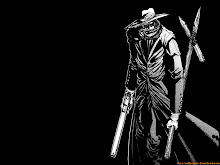
Imatge escapçada del manga Hellsing, escrit i il.lustrat per Kouta Hirano.

Video escapçat del YouTube: Darkness- SadieDammit